

Available on all plans
What is Apify?
Apify is a platform for web scraping, the process of collecting data from websites automatically instead of copying it by hand. It does this through actors: ready-made tools that can pull data from a specific website or platform, from Instagram to Amazon to Google Maps. Macaly reaches into Apify for you. You don’t need an Apify account, and you don’t need to know how any of this works. You describe the data you want, and the agent picks the right actor and handles the rest.What you can build
Plenty of useful projects start with data that already exists somewhere on the internet. The agent collects it for you and turns it into something structured: a page, a catalog, or a dashboard. A few examples of what you can build:- Business website. Build a site from your Google Maps profile. The agent pulls the essentials, including your photos, opening hours, address, and reviews.
- Social media dashboard. Pull posts and profile data from social platforms like Instagram into a dashboard that shows how your content is performing.
- CV or portfolio. Share a link to your LinkedIn profile and the agent pulls your experience, skills, and other details to build a ready-to-publish portfolio or CV.
- Rental site. Take your property listing from Airbnb or Booking and turn it into your own standalone site with descriptions, photos, and reviews.
- Product catalog. Pull products from a store like Amazon or eBay and turn them into a working catalog with filters and detail pages.
How it works
You don’t set anything up. Just describe the data you want as part of what you’re building:1
The agent picks a tool
It finds a suitable actor for the platform you’re targeting, choosing a popular, well-used one. If you already have a specific actor in mind, you can name it and the agent will use it.
2
You confirm the action
Before it loads anything, the agent pauses and asks you to confirm. You’ll see a short confirmation in the chat showing what will be loaded and how many credits the action could use. Choose Yes / Load data to go ahead, or No / Skip to cancel.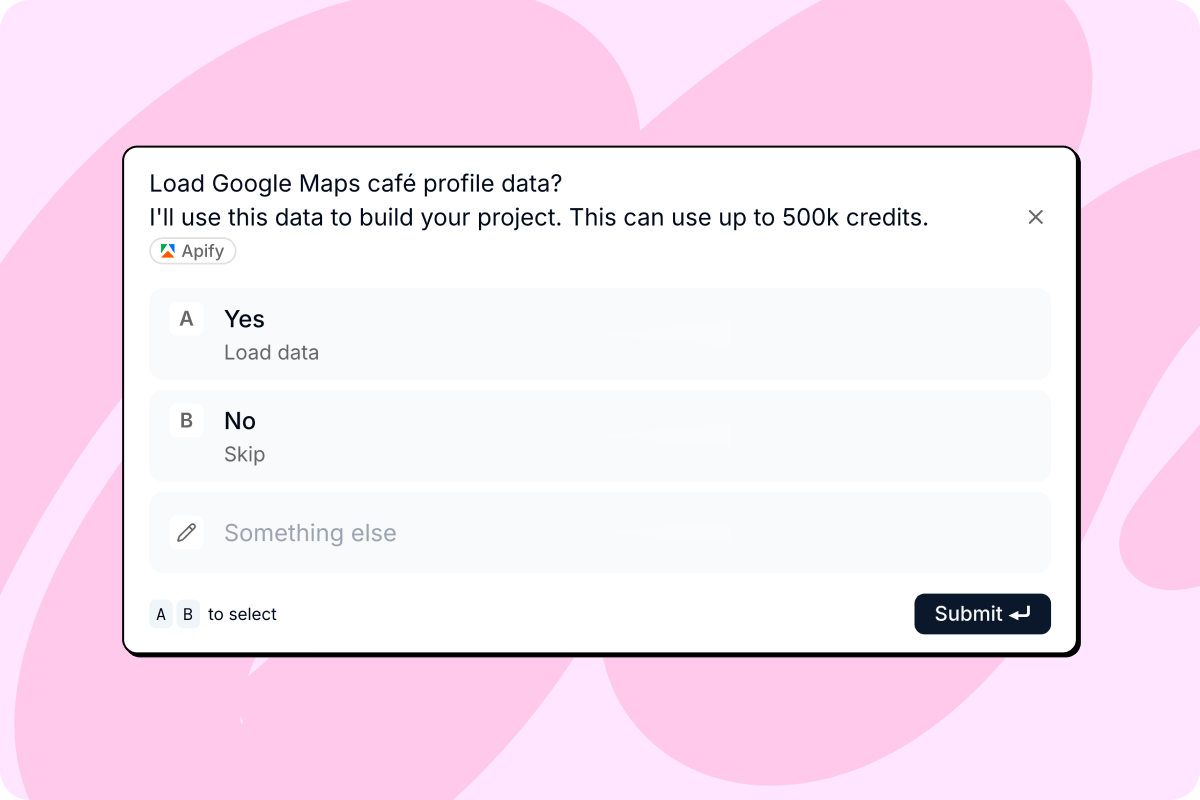
3
The agent builds with the data
Once you confirm, the agent gathers the data and uses it to build your project, the same way it works with any other content.
Credits
Pulling data uses credits, because it fetches real data from the internet through Apify. The exact cost depends on how much data is pulled, so the amount can vary from one request to the next. The agent always asks before it starts pulling data. A single request will never exceed 500k credits. Nothing is loaded, and no credits are used, until you say yes. You confirm each action individually. If the agent needs to try a different tool or pull more data, it asks again.Good to know
- No setup required. You don’t need an Apify account, an API key, or any connection. Just ask the agent for the data you want.
- The agent picks the tool. It chooses a suitable actor for you, but if you’d like, you can pick a specific one.
- You’re always asked first. The agent never pulls data without your confirmation. A single request will never exceed 500k credits.
- Some sources may require a login. Tools that require you to sign in with your own account are skipped automatically.
- If no tool fits, the agent adapts. When there’s no suitable tool for a site, the agent tries to read the content in other ways.