How Does Vibe Coding Compare to Traditional Coding Methods?
Vibe coding (AI-assisted natural language programming) and traditional coding represent two distinct approaches to software development, each with unique strengths and trade-offs. This comparison examines both methods across various dimensions to help you understand which approach might work best for different scenarios.
A person praying in front of a computer hoping their vibe coding app will work
Key Differences at a Glance
| Aspect | Vibe Coding | Traditional Coding |
|---|---|---|
| Development Speed | Rapid prototyping via AI code generation | Slower due to manual implementation |
| Accessibility | Low barrier for non-programmers | Requires formal programming expertise |
| Complexity Handling | Struggles with large-scale projects | Full control over architecture |
| Debugging | Challenging with opaque AI outputs | Direct code inspection simplifies |
| Security | Higher vulnerability risks | Better auditability and control |
Pros and Cons of Vibe Coding
Advantages
- 10x faster MVP creation and prototyping
- Democratizes development for non-programmers
- Automates boilerplate code and testing
- Reduces initial learning curve substantially
- Enables rapid iteration and experimentation
Disadvantages
- 43% higher technical debt risk
- Limited customization in AI outputs
- Opaque decision-making in generated code
- Potential security vulnerabilities
- Difficulty scaling to complex systems
Pros and Cons of Traditional Coding
Advantages
- Full control over performance optimization
- Better scalability for enterprise systems
- Established collaboration patterns
- Greater security through code transparency
- More predictable maintenance processes
Disadvantages
- 6-12 month learning curve for proficiency
- Manual error detection increases development time
- Higher initial development costs
- Requires specialized expertise
- More time-consuming for routine tasks
Efficiency Comparison
The efficiency of each approach varies significantly depending on the context and metrics used for evaluation:
- Prototyping: Vibe coding completes basic web apps in hours versus weeks with traditional methods
- Maintenance: Traditional codebases show 30% lower long-term maintenance costs
- Iteration: AI-assisted refactoring is 5x faster for minor changes
- Quality: Traditional coding typically produces more reliable code for mission-critical systems
- Resource utilization: Vibe coding can reduce developer hours by up to 70% for routine tasks
Cognitive Load Differences
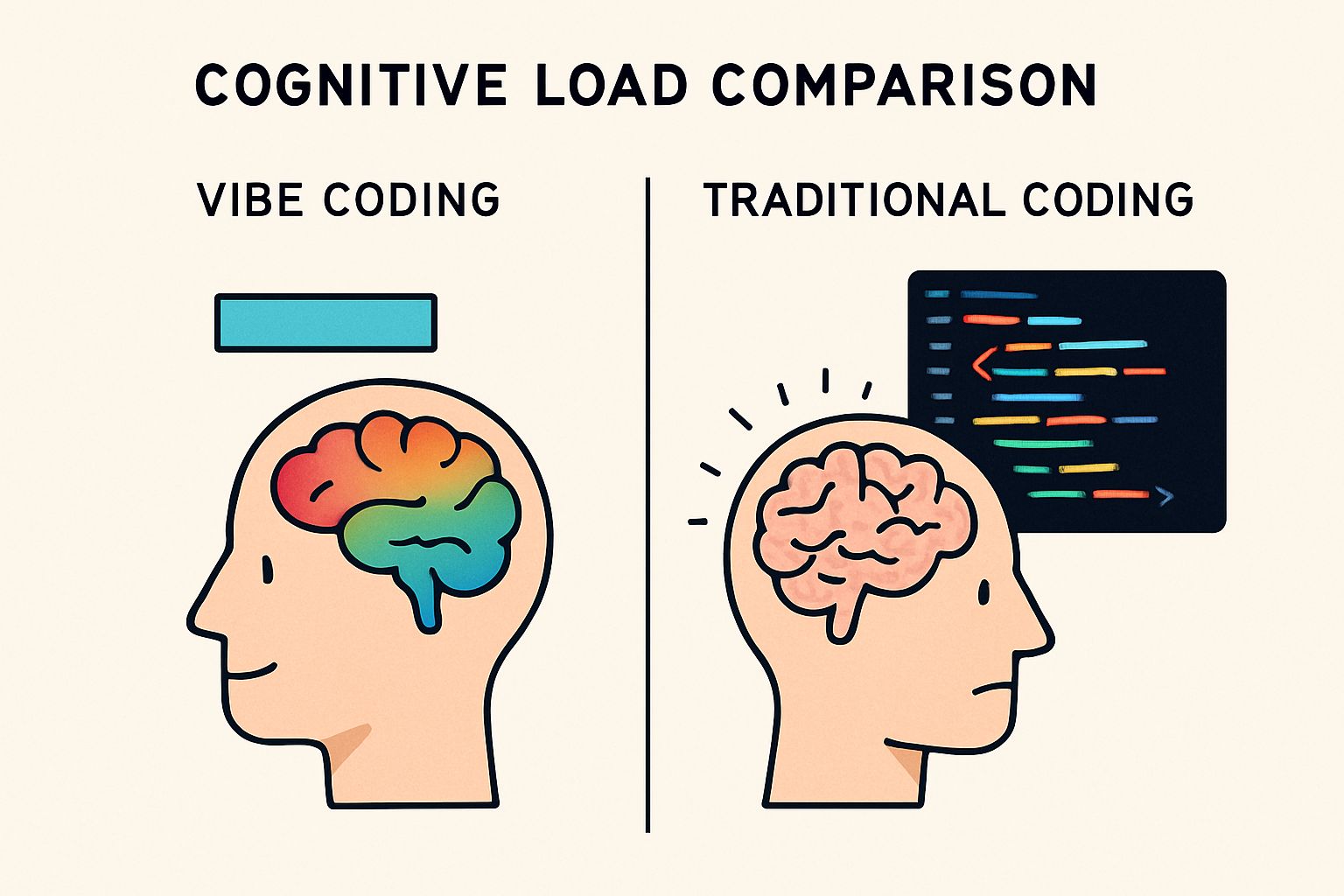
Cognitive load comparison showing colorful brain for vibe coding vs stressed brain for traditional coding
The mental effort required for each approach differs in both quantity and type:
- Vibe coding reduces initial mental effort by 40% through AI assistance
- Traditional coding demands continuous focus on implementation details
- Vibe coding shifts cognitive load from syntax to problem definition
- Traditional coding provides clearer mental models of program execution
- Debugging AI-generated code can sometimes introduce new cognitive challenges
Learning Trajectories
The path to proficiency differs dramatically between these approaches:
Vibe Coding Learning Path
- 2-4 weeks to basic proficiency
- Focuses on prompt engineering rather than syntax
- Emphasizes domain knowledge over technical implementation
- Initial success comes quickly, but mastery of edge cases takes longer
- More accessible to those without formal programming education
Traditional Coding Learning Path
- 6-12 months for full-stack competence
- Requires algorithm and data structure mastery
- Incremental skill building from fundamentals to advanced concepts
- Deeper understanding of computing principles
- Transferable skills across multiple languages and paradigms
Recommended Use Cases
| Scenario | Recommended Approach | Rationale |
|---|---|---|
| Startup MVP | Vibe coding | Speed to market prioritized over scalability |
| Financial transaction system | Traditional coding | Security and reliability requirements |
| Marketing automation | Hybrid approach | Balance of speed and maintainability |
| Open-source libraries | Traditional coding | Collaboration and transparency needs |
| Content websites | Vibe coding | Rapid iteration with lower complexity |
| Enterprise systems | Traditional coding | Long-term support and complex integrations |
| Personal projects | Vibe coding | Quick implementation with minimal resources |
Future Outlook
Current industry trends suggest a convergence model where:
- AI will handle 60-70% of routine coding tasks by 2030
- Traditional skills will remain critical for system design and complex logic
- New roles will emerge for 'AI code auditors' to bridge both approaches
- Educational pathways will blend natural language and traditional programming concepts
- Tools will evolve to provide smoother transitions between the two paradigms
The most effective teams will likely blend vibe coding's speed with traditional coding's rigor, using AI for rapid iteration while maintaining manual control over core systems.
How Macaly Bridges Both Worlds
Macaly is uniquely positioned at the intersection of vibe coding and traditional development. Our platform offers:
- Natural language interfaces for rapid development
- Transparent code generation with review capabilities
- Intelligent suggestions that respect existing code patterns
- Hybrid workflows that combine AI assistance with manual control
- Educational features that help developers understand generated code
This balanced approach allows teams to harness the speed of vibe coding while maintaining the quality and control of traditional methods.
Conclusion
Neither vibe coding nor traditional coding is universally superior—each has distinct advantages depending on your project requirements, team composition, and business goals. For rapid prototyping and projects with limited complexity, vibe coding offers unprecedented speed and accessibility. For mission-critical systems requiring fine-grained control, traditional coding provides necessary reliability and transparency.
As the technology landscape evolves, the most successful development teams will likely adopt a flexible approach, leveraging the strengths of both paradigms while mitigating their respective weaknesses.
Experience the best of both worlds with Macaly. Try our platform today and discover how AI-assisted development can complement your existing workflows.